
EDITOR'S NOTE The creatures were fake. The newspaper was real. This edition separates the spectacular story from the legends that later grew around it—including claims about exactly how many people believed it and how dramatically it changed circulation.
GREAT ASTRONOMICAL DISCOVERIES
NEW YORK WOKE UP
TO ANOTHER WORLD.
On a Tuesday morning in late August, the New York Sun told its readers that the greatest astronomical discovery in human history had already happened. Sir John Herschel, observing from the Cape of Good Hope, had supposedly turned a colossal new telescope toward the Moon and found it teeming with life.
The claim arrived at the perfect moment. Science was advancing fast enough to make yesterday's impossible feel like tomorrow's headline. Herschel was real. His expedition was real. The public knew that stronger telescopes kept pushing the edge of the visible world. The Sun simply placed a magnificent lie one step beyond that frontier.
It did not read like a fairy tale. It read like science arriving faster than skepticism could catch it.
EVERY MORNING,
THE MOON GOT WILDER.
The series unfolded like the first great newspaper cliffhanger. Each installment made the next impossible thing feel almost inevitable.
THE IMPOSSIBLE TELESCOPE
The Sun announces that Sir John Herschel has built an instrument so powerful it can reveal the Moon as clearly as a landscape a few hundred feet away.
A WORLD COMES ALIVE
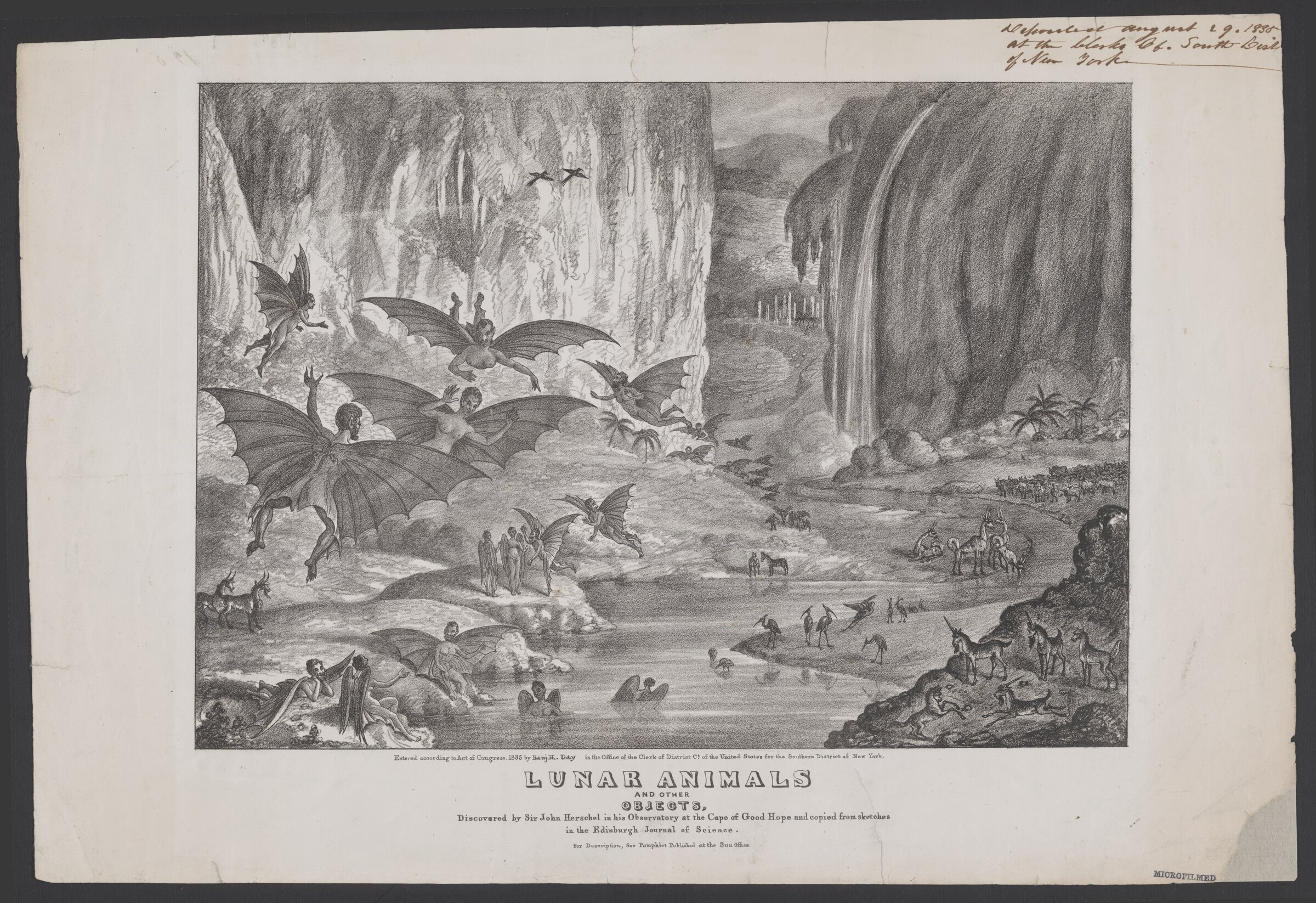
Basalt cliffs, amethyst hills, beaches of white sand, forests and a blue inland sea appear where readers had expected a dead gray sphere.
THE ANIMALS ARRIVE
Bison-like creatures, blue single-horned goats and upright beavers move across the page. The unbelievable is delivered one careful detail at a time.
THE BAT-MEN
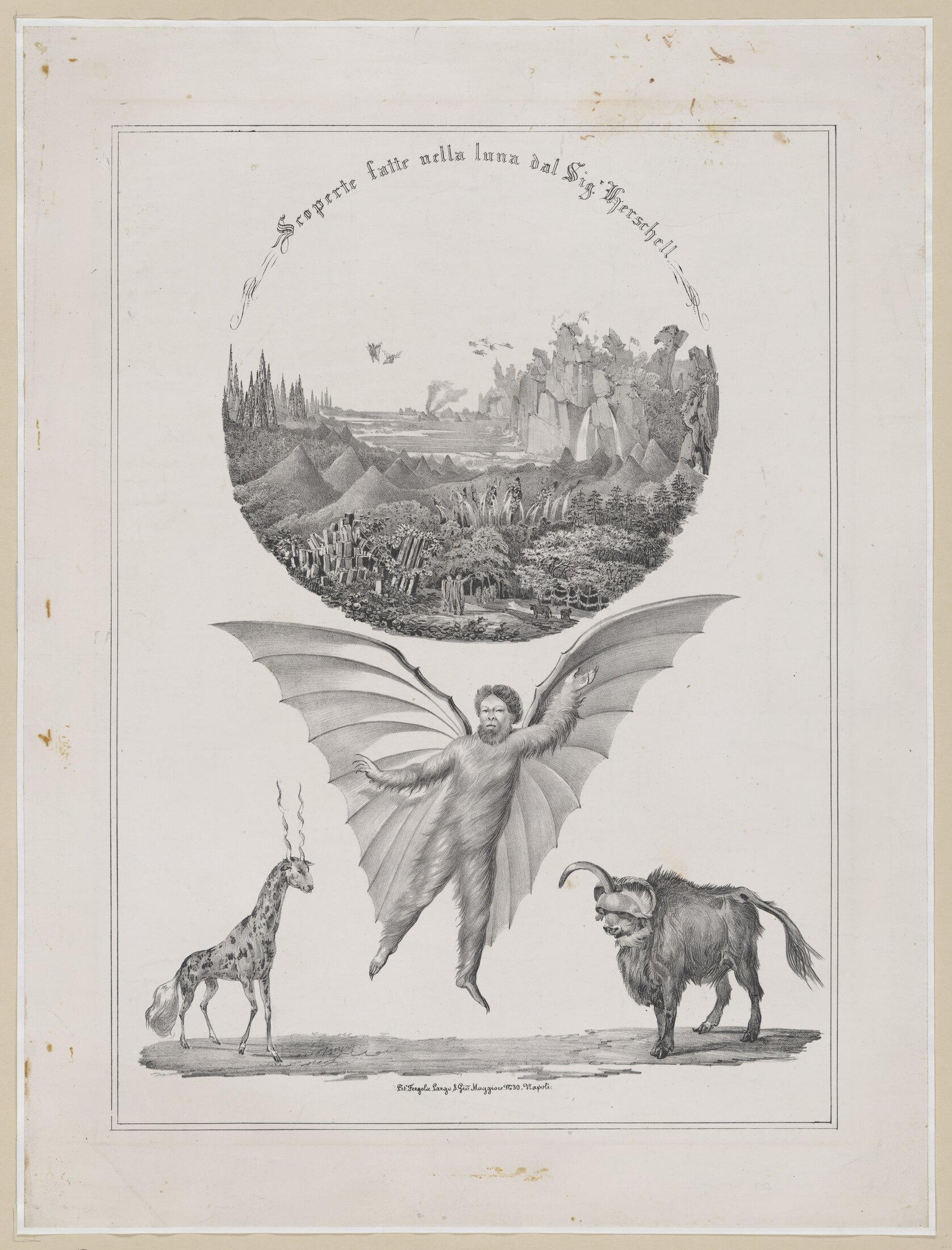
Four-foot winged humanoids enter the story. The paper gives them a scientific name—Vespertilio-homo—and describes them as innocent, happy and capable of conversation.
THE SAPPHIRE TEMPLE
A superior lunar species appears beside a magnificent temple. Columns, roofs and flame-shaped ornaments turn strange wildlife into evidence of civilization.
THE CONVENIENT FIRE
The observations end after sunlight is said to pass through the great lens and ignite the observatory. The perfect evidence machine destroys itself.
HOW TO SELL
THE IMPOSSIBLE.
The story worked because it was engineered. Real names, false authority, technical detail and perfect pacing formed a credibility machine.
BORROW A REAL GENIUS
John Herschel was one of the most respected astronomers alive and really was observing the southern sky near Cape Town. The lie arrived wearing a true man’s reputation.
INVENT A DEAD SOURCE
The reports claimed to come from a supplement to the Edinburgh Journal of Science. The title sounded authoritative. The journal had already ceased publication under that name.
BURY ABSURDITY IN DETAIL
A 24-foot lens. Seven tons of glass. A hydro-oxygen microscope. Locke did not ask readers to leap into fantasy. He walked them there through technical language.
SERIALIZE THE REVEAL
Each issue escalated the wonder. Landscape became animals. Animals became people. People became civilization. By the time bat-men appeared, readers had already accepted the Moon’s forests.
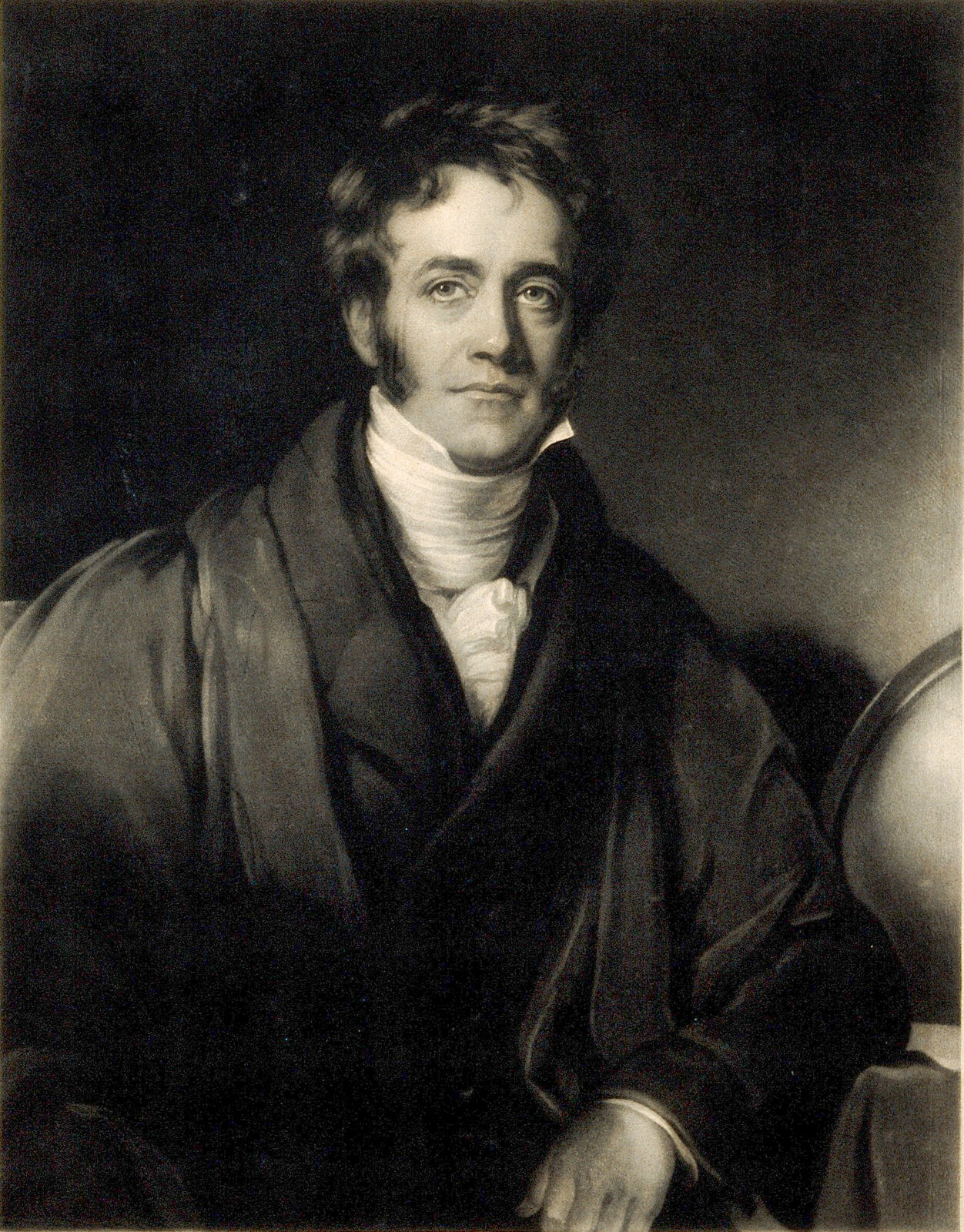 THE NAME THEY STOLE
ONE LOOKED
AT THE SKY.
ONE WROTE THE LIE.
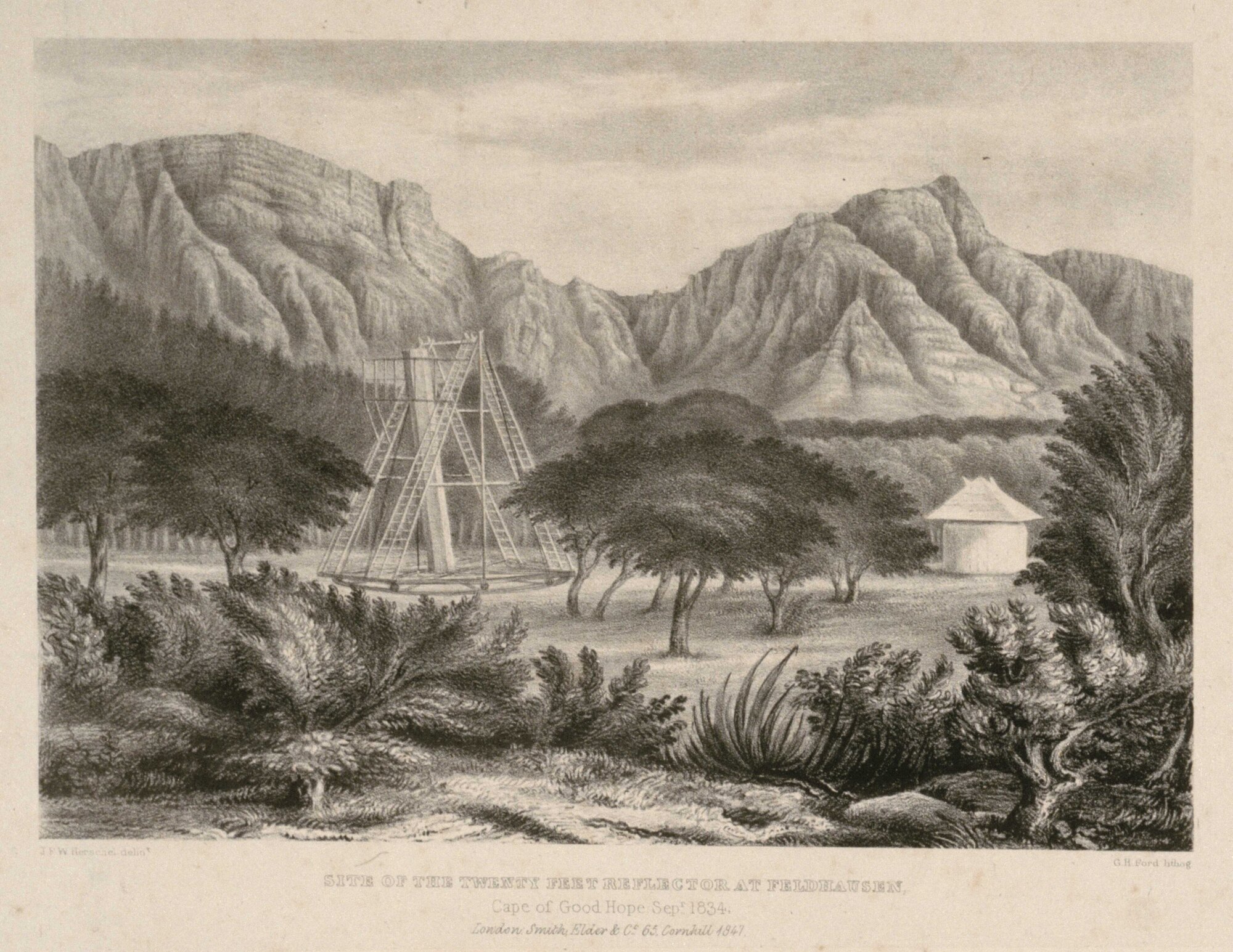
The celebrated astronomer was at Feldhausen near Cape Town conducting a real survey of the southern heavens. He had nothing to do with the Sun's discoveries and knew nothing about the articles when they began.
The Sun writer behind the series later described it as satire. His target was the era's grand, religiously charged speculation about inhabited worlds. The joke became a hoax because the audience accepted the setup.
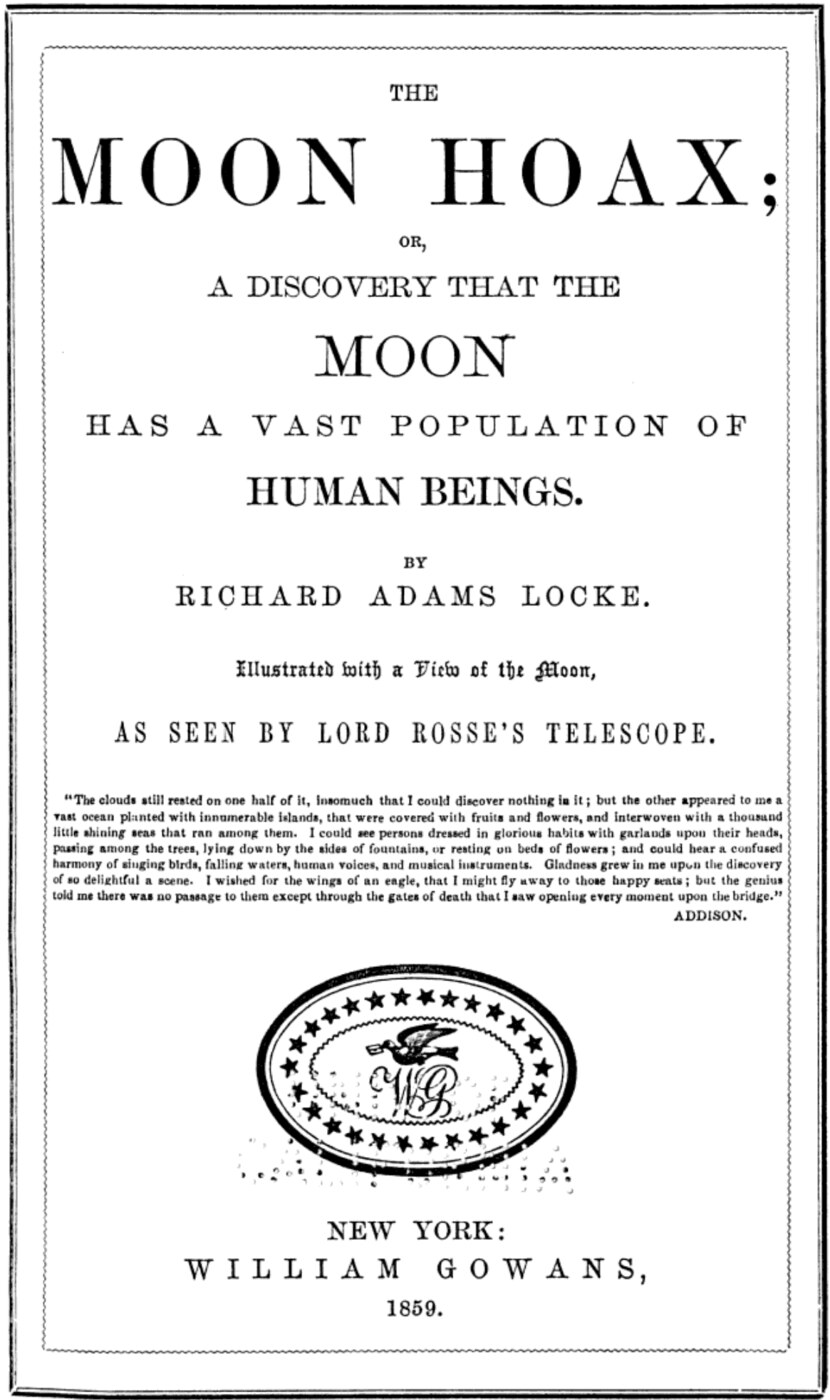
THE MOON DIDN'T CHANGE.
THE STORY DID.
Contemporary readers plainly found the series compelling, and it was widely reprinted. But later accounts often turned that excitement into a cleaner legend of universal belief. The surviving record does not let us count the convinced with precision.
Competing newspapers questioned details, mocked the reports and tried to verify their supposed source. The hoax did not collapse in one cinematic confession. It gradually became impossible to sustain.
The paper survived the deception and absorbed the attention. Claims that the hoax instantly made it the world's highest-circulation newspaper are difficult to prove, but the stunt permanently attached the Sun's name to the story.
Edgar Allan Poe had published his own lunar voyage, “Hans Pfaall,” only weeks earlier. He suspected theft, then later conceded that Locke probably had not seen it. Journalism's strangest Moon race had two writers and no spacecraft.
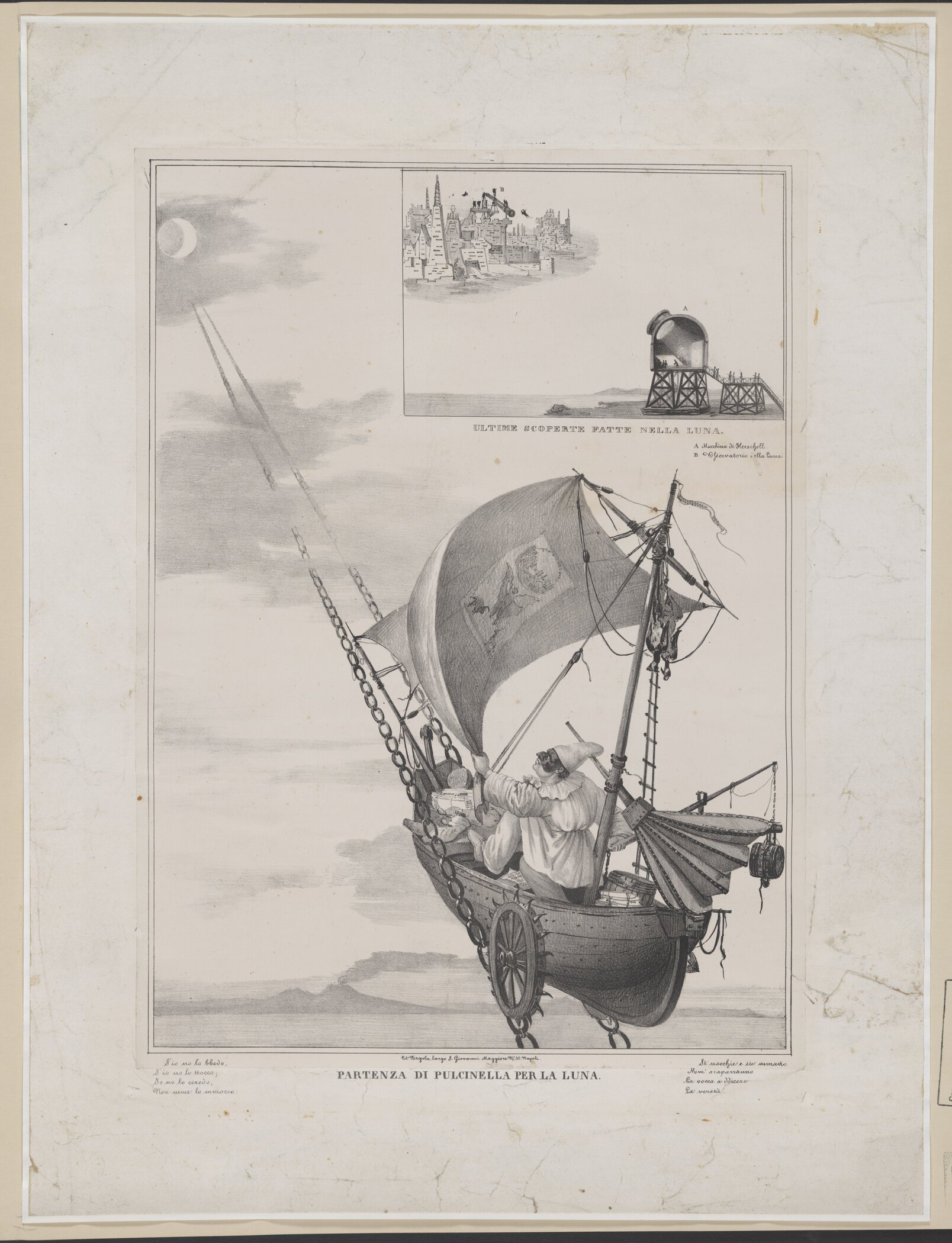
THE TECHNOLOGY CHANGED.
THE WEAK SPOT DIDN'T.
The Great Moon Hoax was not merely a story about gullible people in an ignorant age. It was a demonstration of something modern readers know too well: information becomes persuasive when it borrows authority, rewards hope, arrives in a familiar format and is repeated before verification catches up.
In 1835, the delivery system was a one-cent newspaper and boys shouting in the street. Today it is instant, global and tuned to the reader. The machinery is new. The appetite for wonder is ancient.
THE FIRST VIRAL LIE DID NOT NEED AN ALGORITHM.IT ONLY NEEDED A CROWD THAT WANTED THE NEXT INSTALLMENT.